
“The question is no longer: ‘Can AI do this?’ The question now is: ‘How do we govern it?”
If you’ve sat in an executive boardroom recently, you’ve likely heard the word “agentic” thrown around like a magic wand. Vendors promise autonomous systems that will revolutionize your workflows, but a single question often brings those pitches to a grinding halt:
“Show me one AI decision your company made this quarter that a human didn’t initiate.”
Most rooms go quiet.
That silence represents the massive gap between enterprise AI marketing and actual production reality.
While many organizations claim to be implementing “Agentic AI,” most are still deploying chatbots, copilots, or workflow automations. Valuable technologies, certainly, but not truly agentic systems.
As AI adoption accelerates and regulations tighten, understanding that distinction is becoming critical.
In this episode of The Agentic Enterprise podcast, Lucia Italiano (AI Strategy & Governance Leader) and Rantej Singh (Founder of Eligere Technologies) broke down exactly what it takes to deploy AI at scale in complex, regulated environments.
Here are the critical insights every enterprise leader needs to know to move past the hype and build a scalable, compliant AI strategy.
What Is Agentic AI?
Many organizations are paying a premium for what they think are AI agents, but are actually just workflow automations with a language model on top. For instance, combining Robotic Process Automation (RPA) with GPT-4 creates a faster, more flexible system, but it is not agentic if a human is still involved in every single step. The simplest test is this:
Can the AI system decide to take an action without a human asking it to do so at that moment?
A chatbot responds. A copilot suggests. A human must initiate the next move.
Meanwhile, an agent initiates. True agents perceive their environment, determine that action is required, and take that action autonomously.
This distinction may sound technical, but it has profound implications for governance, compliance, security, and operational risk.
Why Governance Changes Everything
Traditional automation follows predefined instructions. When something fails, it usually fails in predictable ways. For example, a broken data format stops the process
Agentic systems operate differently. An autonomous agent, however, might recognize a data gap and proactively seek alternative internal or external sources to solve the problem by making independent decisions.
While highly efficient, this autonomy introduces the risk of completely unanticipated outcomes, requiring an entirely new approach to governance.
That’s where many enterprises face new challenges.
The Hidden Risks: “AI Sprawl” and Ghost Data
Because generative AI has drastically lowered the barrier to building internal tools, engineers and teams are spinning up prototypes in a fraction of the time. This has triggered two massive enterprise headaches:
1. AI Sprawl
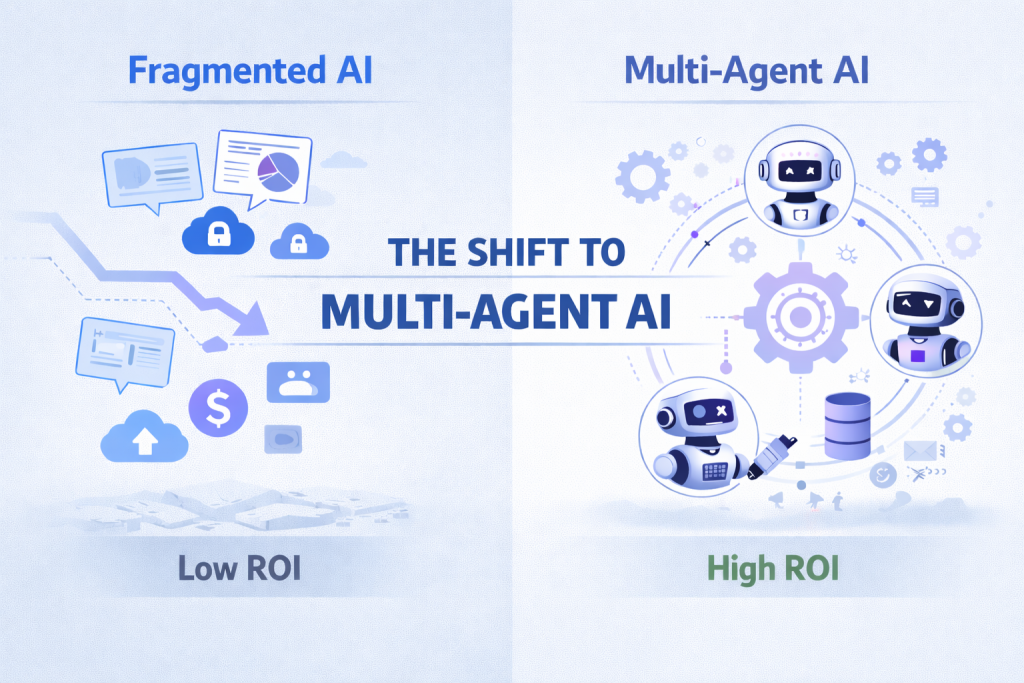
AI is lowering the barrier to building new tools, agents, and workflows. That’s great for innovation but it also creates a new enterprise challenge: AI sprawl.
When every team can create AI-powered solutions independently, organizations can quickly lose track of what exists, which data is being used, and where sensitive information is flowing. The result is a growing patchwork of duplicate tools, disconnected knowledge assets, and governance blind spots.
The consequences include:
- Duplicate AI tools solving the same problem
- Siloed data and knowledge repositories
- Poor visibility into AI usage and performance
- Greater compliance and security exposure
- Escalating costs and operational complexity
AI isn’t the problem. Lack of governance is.
The organizations succeeding with AI today aren’t moving slower—they’re building the governance foundations that allow them to scale faster with confidence.
2. Derived Data Artifacts (The Ghost Data Problem)
AI doesn’t just consume data, it creates new versions of it.
Every summary, embedding, knowledge base, or generated insight becomes a derived artifact that may live independently of the original source. The problem? When the source data is deleted, restricted, or updated, those AI-generated artifacts don’t always follow suit.
As a result, AI agents can continue to access and surface information that should no longer be available, creating serious governance, security, and compliance risks.
For organizations operating under GDPR and emerging AI regulations, the question is no longer just who can access the original data? It’s also what has your AI already learned, stored, and retained from it?
That’s a governance challenge many enterprises are only beginning to confront.
This is no longer simply an IT issue; it becomes a compliance issue.
3. The Cost of Vendor Lock-In
Many enterprises are solving today’s AI challenges while unknowingly creating tomorrow’s dependency problem.
By building agents, workflows, and integrations around a single AI provider, organizations can move quickly in the short term. But as adoption scales, that convenience can turn into lock-in.
The warning signs are familiar:
- Escalating token costs
- Reduced freedom to switch models
- Expensive migration efforts
- Limited bargaining power
- Growing dependence on a single ecosystem
The most resilient AI strategies aren’t built around a specific model. They’re built around the ability to change models.
That’s why forward-thinking enterprises are investing in model-agnostic AI architectures that provide choice, flexibility, and control, regardless of how the AI market evolves.
The Solution: Building a Central AI Command Center
Successful AI adoption isn’t about deploying more agents.
It’s about creating the infrastructure that allows agents to scale safely.
This is where the concept of a Central AI Command Center or Multi-Agent Orchestration Platform becomes essential.
This core infrastructure provides four non-negotiable capabilities:
|
Capability |
What It Means for Your Enterprise |
|
Reusable Components |
Instead of rebuilding capabilities repeatedly, teams can reuse AI components and agents for drastically faster scaling. |
|
Centralized Governance |
Leaders gain visibility into what AI systems are doing, what data they access, and how decisions are made. Full observability, central monitoring, and clear audit trails across all functions. |
|
Maintain Model Flexibility |
The freedom to switch or upgrade underlying AI models at any time to control token costs without rebuilding entire systems. |
|
Keep Control of Their Data |
Deployment within an organization’s own cloud environment preserves security, ownership, and compliance: your cloud, your data, your control. |
Navigating the Regulatory Landscape (EU AI Act & GDPR)
For organizations operating in the EU and Swiss markets, AI governance is no longer a future consideration; it’s a current business priority.
As the EU AI Act moves toward enforcement, organizations deploying AI in regulated environments face increasing expectations around transparency, human oversight, data governance, and accountability. For enterprise leaders, compliance is no longer an afterthought; it must be built into AI initiatives from the start.
As a result, the conversation in boardrooms is changing.
It is no longer:
“Can AI do this?”
It is now:
“How do we govern it?”
The organizations moving fastest with AI understand a critical truth: governance is not a compliance burden. It is the foundation that makes AI deployable, trustworthy, and scalable across the enterprise.
Without governance, AI remains a promising experiment.
With governance, it becomes a sustainable business capability.
One Question Every Enterprise Should Ask
If you’re evaluating an Agentic AI platform, ask vendors a simple question:
Can you show the audit trail of a real production decision made by an AI agent?
Can they demonstrate:
- What the agent considered
- Why it made a decision
- What action it took
- How that action can be reviewed
If not, explainability may not be built into the platform.
And without explainability, scaling AI in regulated environments becomes significantly more difficult.
The Bottom Line
Agentic AI is not just another AI trend.
It’s a shift from systems that assist humans to systems that can act on behalf of organizations.
That shift creates enormous opportunities—but also introduces new governance, compliance, and operational challenges.
The organizations that will succeed are not necessarily those deploying the most AI.
They will be the ones building the right foundation for AI to operate safely, transparently, and at scale.
The future of enterprise AI isn’t just about intelligence.
It’s about control.