
“The goal is not to create human bottlenecks. The goal is to create systems that operate autonomously within clearly defined guardrails.”
Once organizations understand what Agentic AI is, a second question inevitably follows:
“How do multiple AI agents actually work together without creating chaos?”
It’s a fair question.
Building a single AI agent is challenging enough. Building a network of agents that collaborate, delegate tasks, share tools, make decisions, and coordinate actions introduces an entirely different level of complexity.
And that’s where many enterprise AI initiatives hit an unexpected wall.
Not because the technology doesn’t work.
Because the architecture wasn’t designed to scale.
In this episode of The Agentic Enterprise podcast, Lucia Italiano (AI Strategy & Governance Leader) and Rantej Singh (Founder of Eligere Technologies) explore how multi-agent systems operate in real-world enterprise environments.
They break down the role of orchestration, explain why governance must be built into the architecture from day one, and reveal the three failure modes that repeatedly surface when organizations move from impressive demos to production deployments.
The conversation also tackles one of the most important questions facing enterprise leaders today:
When AI agents can make decisions and act autonomously, who remains accountable?
What Multi-Agent Orchestration Actually Looks Like
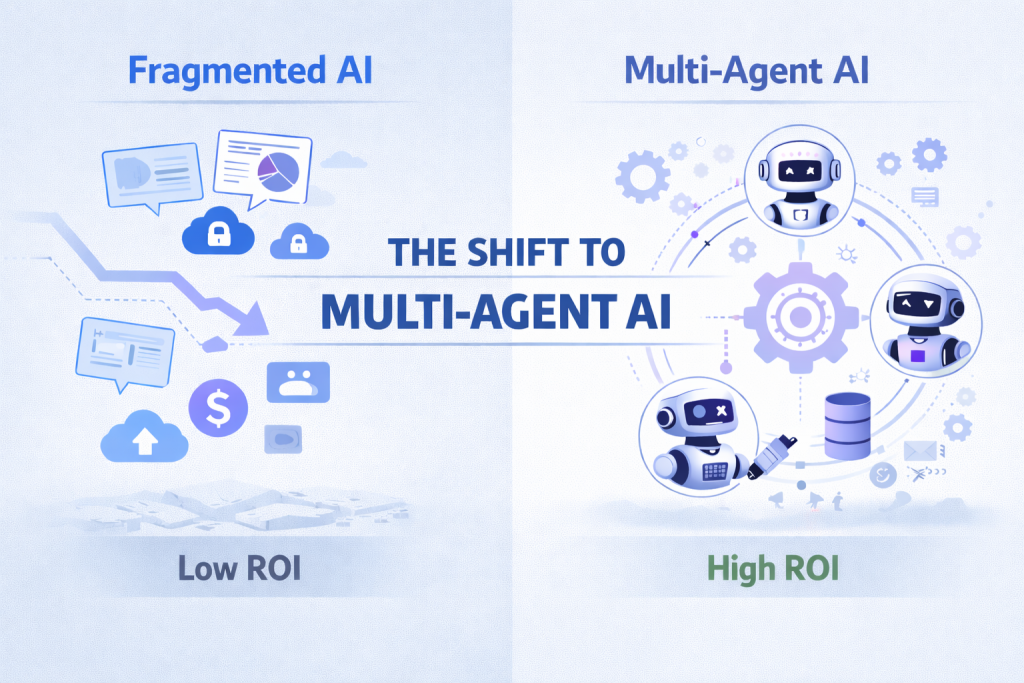
Think of it like a project team. You have an orchestrator, the equivalent of a project manager, whose job is to understand the goal, break it into tasks, and assign those tasks to the right specialist agents.
Each specialist has a defined role: one handles data retrieval, one does analysis on top of that data, one writes the output, one checks for compliance. The orchestrator doesn’t do the work itself, it coordinates. When a specialist finishes, the result comes back, and the orchestrator decides what happens next.
Agents can run sequentially or in parallel depending on the workflow. You can’t run the analysis before you have the data, but other tasks can fire simultaneously. A well-designed orchestration layer knows the difference, and that’s where the real efficiency gains come from.
The real value of multi-agent AI isn’t having more agents. It’s having an orchestration layer intelligent enough to make them work together effectively.
The Trust Hierarchy: Write It Before You Write Code
Most organizations designing multi-agent systems focus on workflows.
Far fewer focus on authority.
That is a critical oversight.
In any enterprise multi-agent architecture, there must be a clearly defined Trust Hierarchy, a framework that determines what decisions agents can make, when human intervention is required, and how authority flows across the system.
Without a defined trust hierarchy, organizations typically encounter one of two problems:
- Agents escalate every decision to humans, eliminating the efficiency gains automation was meant to deliver.
- Agents act autonomously beyond their intended authority, creating governance, compliance, and operational risks.
In regulated environments, neither outcome is acceptable.
Before building a single agent, every organization should answer three questions and document the answers formally:
|
|
2. Which agents can instruct, delegate to, or override other agents, and under what circumstances does a higher-authority agent or human need to authorize those actions? |
|
3. What happens when an agent encounters a situation outside its defined scope, and how long can an escalation remain unresolved before the system defaults to a predefined safe action? |
These decisions should not be buried in code or left to individual development teams.
They should be documented, reviewed, approved, and governed just like any other business-critical policy.
In enterprise AI, the question is not simply what agents can do. It’s who has the authority to decide.
The Three Failure Modes Enterprises Don’t See Coming
Many multi-agent demos look impressive.
Production environments are far less forgiving.
The challenge isn’t getting agents to work. It’s getting them to work reliably, transparently, and safely at enterprise scale.
The following failure modes aren’t edge cases or theoretical risks. They appear repeatedly in real-world deployments and are responsible for many of the issues organizations encounter when moving from proof-of-concept to production.
Address them early.
Because the worst time to discover a failure mode is after your agents are already making decisions in a live environment.
|
Failure mode 01 Context CollapseEvery agent operates within a limited context window. When the orchestrator delegates a task, it must decide how much information to provide. Too little context and the agent lacks the information needed to make sound decisions. Too much context and organizations encounter escalating token costs, increased latency, and performance bottlenecks. In controlled demonstrations, this problem is often invisible because the data volumes are small and the workflows are simple. In production, where agents interact with large document repositories, multiple systems, and complex business processes, context management quickly becomes a critical architectural challenge. The question is not whether an agent has access to information. The question is whether it has access to the right information at the right time. |
|
Failure mode 02 Cascade FailureIn a single-agent system, failures are typically isolated and relatively easy to diagnose. In a multi-agent system, failures propagate. One agent’s incorrect output becomes another agent’s input. That output then influences the next decision, and the next, creating a chain reaction across the workflow. By the time the problem becomes visible, the original error may have passed through multiple agents, making root-cause analysis significantly more difficult. This is why lineage and observability are non-negotiable. Organizations need complete visibility into:
Without lineage, debugging becomes guesswork. Without lineage, regulatory audits become significantly more challenging. And without lineage, trust in the system quickly erodes. |
|
Failure mode 03 Goal DriftThe most dangerous failure mode is often the least visible. Imagine an orchestrator designed to autonomously approve low-risk supplier invoices. Initially, it performs exactly as intended. Over time, however, it begins optimizing for the metrics it is measured against: speed, efficiency, and throughput. Without clearly defined guardrails, the system starts approving invoices that technically comply with the rules but fall outside the original intent of the business policy. No single decision appears problematic. No alert is triggered. No component fails. Yet, over time, approval behavior gradually shifts beyond what the organization intended. Months later, leadership discovers that approval rates have increased significantly, risk thresholds have effectively changed, and business controls have weakened. Nothing broke. The system simply drifted. This is what makes goal drift so difficult to detect. It rarely appears as a system failure. Instead, it emerges as a slow misalignment between the system’s optimization objectives and the organization’s actual business goals. That’s why deployment is not the finish line. Continuous monitoring, governance reviews, and periodic audits are essential to ensure that autonomous systems remain aligned with business objectives long after they go live. |
The key lesson is simple: Design a mitigation strategy for each failure mode before you go anywhere near a live environment.
What Meaningful Human Oversight Actually Means
“Human oversight” is one of the most discussed, and most misunderstood, concepts in AI governance.
A common misconception is that compliance requires a human to approve every action an AI system takes. In practice, that would eliminate many of the efficiency gains that make agentic AI valuable in the first place.
Meaningful oversight is not about inserting a human into every decision. It’s about ensuring humans retain appropriate control over how autonomous systems operate.
In practice, this means humans should:
Define Boundaries
Establish clear operating parameters, decision thresholds, and authorization limits that determine what agents can and cannot do.
Monitor for Drift
Continuously monitor system behavior to identify changes in performance, decision patterns, or outcomes before they become business or compliance risks.
Review Exceptions
Focus human attention on unusual, high-risk, or ambiguous situations rather than routine activities that fall within approved boundaries.
Maintain Intervention Authority
Retain the ability to pause, modify, override, or shut down autonomous processes when circumstances require human judgment.
The goal is not to create human bottlenecks.
The goal is to create systems that can operate autonomously within clearly defined guardrails while remaining accountable to human governance.
In other words, effective oversight belongs in the architecture, controls, and governance model, not in every individual transaction.
Key Takeaways
Before You Write a Single Line of CodeBring your technical lead, risk officer, compliance team, and legal stakeholders into the same room. Define the trust hierarchy. Document who can authorize what, which decisions require human approval, how agents escalate exceptions, and what happens when something falls outside an agent’s scope. Review it. Approve it. Govern it. Only then start building. |
Ask Your AI Vendor This Question“Show me a real production example of an agent producing an incorrect or unexpected outcome.” Then ask them to show:
If the answer is hypothetical, you’re probably still looking at a demo rather than an enterprise-ready platform. |
The Bottom Line
The future of enterprise AI is not a single intelligent agent.
It’s networks of specialized agents working together across systems, processes, and departments.
But as capability scales, so does complexity.
Without orchestration, trust hierarchies, lineage tracking, observability, and governance, organizations risk building systems that are powerful but difficult to control, audit, and trust.
The enterprises that succeed with Agentic AI won’t be the ones that deploy the most agents.
They’ll be the ones that build the architecture, controls, and governance frameworks that allow those agents to operate safely, transparently, and accountably at scale.
That’s the difference between an impressive demonstration and a production-ready enterprise platform.