
“The problem isn’t that AI doesn’t work. It’s how it’s being implemented.”
Over the last few years, almost every large enterprise has started adopting AI.
There are chatbots answering internal queries, copilots assisting teams, machine learning–powered dashboards, and automation scripts running in the background. On the surface, AI adoption looks like a success.
But step into a CXO review meeting, and a different reality emerges.
Despite significant investment, most organizations struggle to point to clear, measurable business outcomes. Costs are rising, pilots are abundant, yet impact remains limited. In fact, while nearly 80% of enterprises have adopted AI, only a small fraction—around 5–10%—are seeing real ROI.
The problem isn’t that AI doesn’t work.
It’s how it’s being implemented.
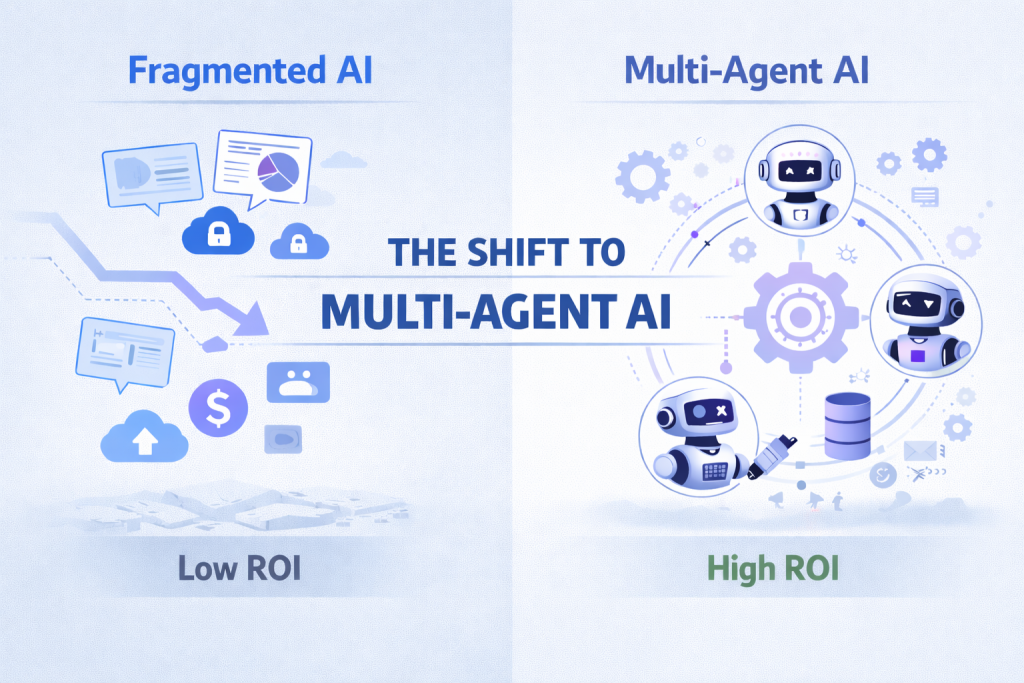
What many enterprises have today is not a cohesive AI strategy, but a collection of disconnected experiments—isolated tools, siloed initiatives, and one-off use cases that fail to scale.
To unlock real ROI, enterprises need to move beyond fragmented adoption and toward something far more powerful:
AI that doesn’t just assist—but actually executes work.
Reasons Why Enterprise AI Isn’t Delivering Impact
Problem #1: AI is Fragmented Across the Organization
Different teams are doing their own AI projects. None of these systems talk to each other or reuse capabilities.
Result: duplicate effort, higher cost, no enterprise-wide impact.
AI remains siloed… instead of becoming a compounding capability.
Problem #2: AI is Not Connected to Real Workflows
Most AI today answers questions and/or generates content. But it does not execute tasks, trigger business processes, and integrate into systems.
For example:
- A chatbot may recommend what to do in a repair scenario
- But it doesn’t initiate the process, update systems, or complete the task
This is where CXOs feel AI is ‘interesting but not impactful.’
Problem #3: Lack of Governance
Many enterprises run pilots and POC demos, but fail to scale because there is no unified platform, no governance, and no reusable architecture. CXOs worry about data privacy, compliance, AI hallucinations, and the lack of auditability.
Without governance, AI cannot evolve from experiments to enterprise systems.
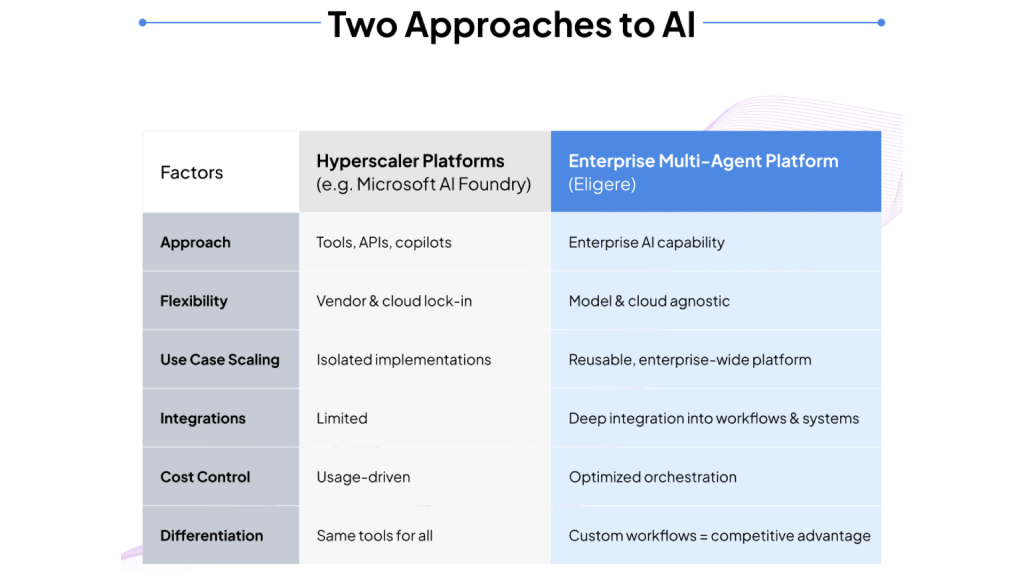
Problem #4: Vendor Lock-in and Cost Risk
Many companies start with Azure OpenAI, Salesforce AI, Google AI, etc., but soon realize they are tied to one ecosystem. Costs increase over time, and switching becomes almost impossible.
AI token/inference costs can scale very fast. AI inference cost can become one of the largest variable expenses.
Some CTOs describe it as ‘our fastest-growing cost center
The Shift: From Copilots to Execution Systems
The next phase of AI is not about more copilots. It’s about making AI responsible for outcomes. It is about multi-agent AI systems.
Enter: Multi-Agent AI Systems
Instead of a single AI answering questions, multiple AI agents collaborate to execute the business workflows. Together, they complete the task end-to-end.
This is the shift from:
- Assistance → Execution
- Insight → Action
- Tools → Systems
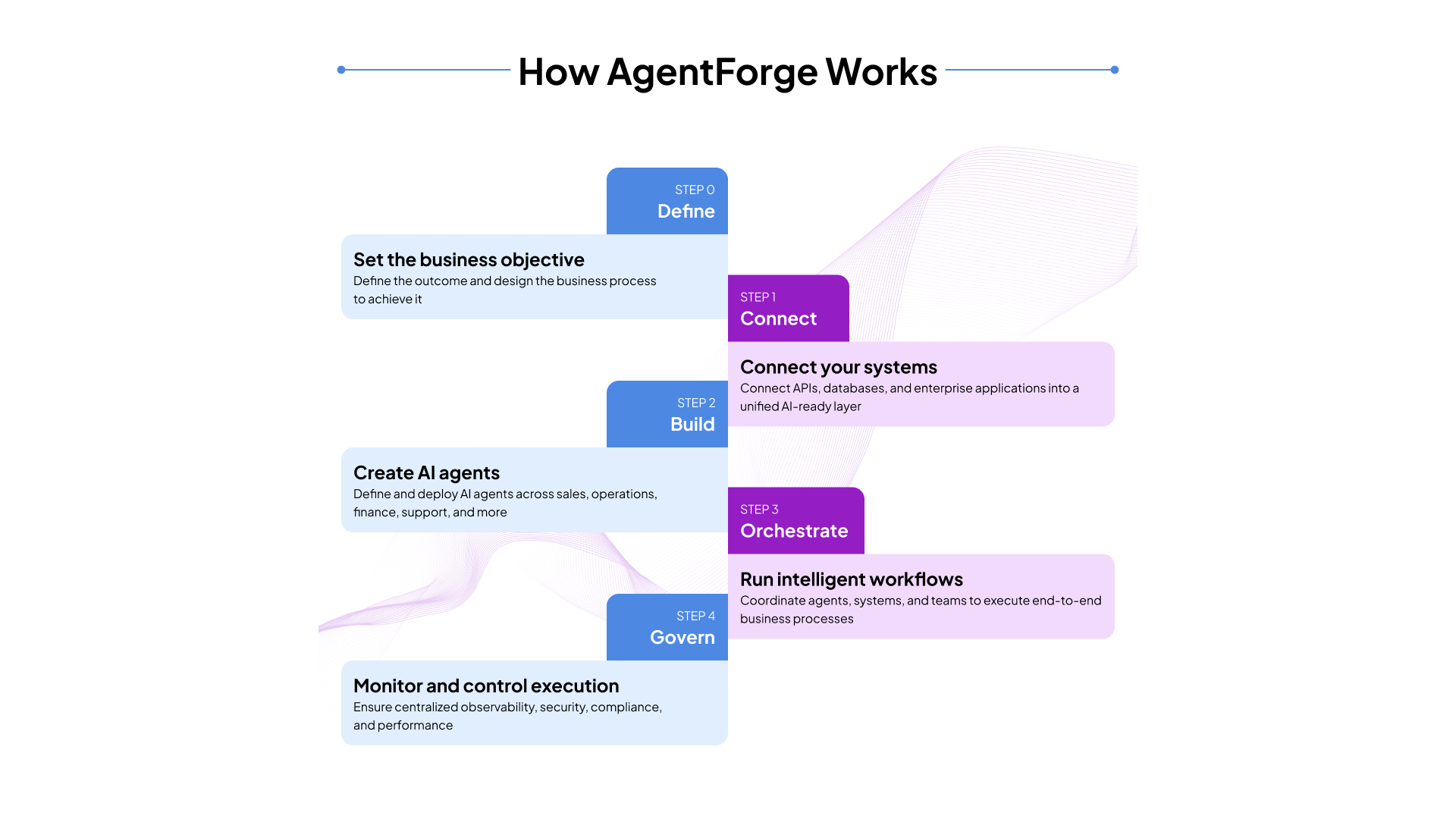
How a Multi-Agent AI Platform Works
Think of it as building a digital workforce embedded into your enterprise systems:
Step 0 – Define the outcome and design the business process
Step 1 – Connect APIs, databases, and enterprise applications
Step 2 – Reuse and deploy AI agents with no code / low code simplicity
Step 3 – Coordinate agents to execute end-to-end processes
Step 4 – Ensure centralized observability, security, and compliance
An enterprise multi-agentic AI platform solves the pilot-to-scale problem for enterprise AI adoption.
The result:
- AI that doesn’t just support decisions.
- AI that completes work.
Why Eligere?
Eligere is your ideal partner to build an Enterprise AI Platform. Eligere is an enterprise AI specialist that:
- Designs the architecture customized for your organization
- Builds the platform layer
- Integrates into business workflows
- Enables your teams through knowledge transfer
a. What Eligere Brings
-
Multi-Agent Platform Design – system of agents working together – AgentForge
-
Reusable AI Components – reusable building blocks for faster scaling across use cases
-
Deep Enterprise Integrations – connect AI to your ERP, CRM and other systems so that AI becomes part of real work
-
Model-Agnostic Architecture – you can use any model and you can switch anytime
-
Deployment on Your Infrastructure – your cloud, your data, your control
-
Governance & Observability – to ensure full visibility, audit trails and compliance in AI deployments across the organization
b. Our Approach: Co-Creation Model